
Ultrahuman Ring AIR Review: Is the Cycle & Ovulation Pro PowerPlug Worth it for Travellers?
I’ve been tracking my cycle on and off for years. Clue, Flo…I’ve cycled through them all (pun intended). And to be fair, they’re not bad apps. The problem isn’t the apps. The problem is me and the way I travel.

Remembering to log symptoms when you’re catching an early morning flight, navigating a new city, or collapsing into bed at midnight after a long day of exploring? It just doesn’t happen consistently. And an app is only as good as the data you put into it. Garbage in, garbage out – or in my case, half-logged, only-when-I-remembered in, wildly inaccurate predictions out.

I’ve been wearing the Ultrahuman Ring AIR for a year now and have been using the Cycle & Ovulation Pro PowerPlug specifically for my cycle tracking over the past couple of months. It works differently from any app I’ve used before – and that difference is the whole point.

Quick FAQs
What makes this different from a regular period tracking app?
Apps like Clue or Flow rely on you logging data – symptoms, moods, dates. The Ultrahuman ring collects temperature and heart rate variability data passively, every night while you sleep, and uses those physiological signals to map your cycle. No logging required beyond noting when your period starts.
Where does the technology come from?
The Cycle & Ovulation Pro PowerPlug is powered by an adapted version of OvuSense Technology – a fertility tracking algorithm developed over 15 years and trained on over 260,000 cycles with medical-grade sensors. It’s backed by 13 peer-reviewed clinical publications. Ultrahuman acquired the company behind it (viO HealthTech) in 2025 and adapted it for the ring.
How accurate is it?
Ultrahuman claims over 90% accuracy for ovulation confirmation – validated using both LH and progesterone testing. For context, most period apps predict ovulation based on cycle averages, not your actual physiological data.
Is it suitable for people with irregular cycles?
Yes, this is one of the things that sets it apart. Most tracking apps are built around a standard 28-days cycles. The Cycle & Ovulation Pro PowerPlug is specifically designed to work for diverse cycle patterns, including people with PCOS or endometriosis.
How long until the data is useful?
Give it 2-3 cycles. The first is largely calibration. By the second and third you start to see patterns you can actually do something with.
Why Passive Tracking Changes Everything
The core issue with manual cycle apps when you travel is consistency. Tracking works when you do it every day. But travel makes every day unpredictable.
The Ultrahuman ring sidesteps this entirely. It's reading your skin temperature and heart rate variability while you sleep. Data that doesn't require you to remember anything. By the time you open the app in the morning to check your sleep score, it's already done the work.
The Cycle & Ovulation Pro PowerPlug layers on top of that data and uses it to do what OvuSense's technology was originally built to do: identify the temperature patterns that signal where you are in your cycle. Not based on the average woman's cycle, but based on yours specifically, building a more accurate picture over time.
The original OvuSense algorithm was developed as a Class II medical device over 15 years, trained on over 260,000 cycles collected with medical-grade sensors. That's a meaningfully different foundation than a consumer app working off a 28-day calendar average.
What a Few Months of Data Actually Looks Like
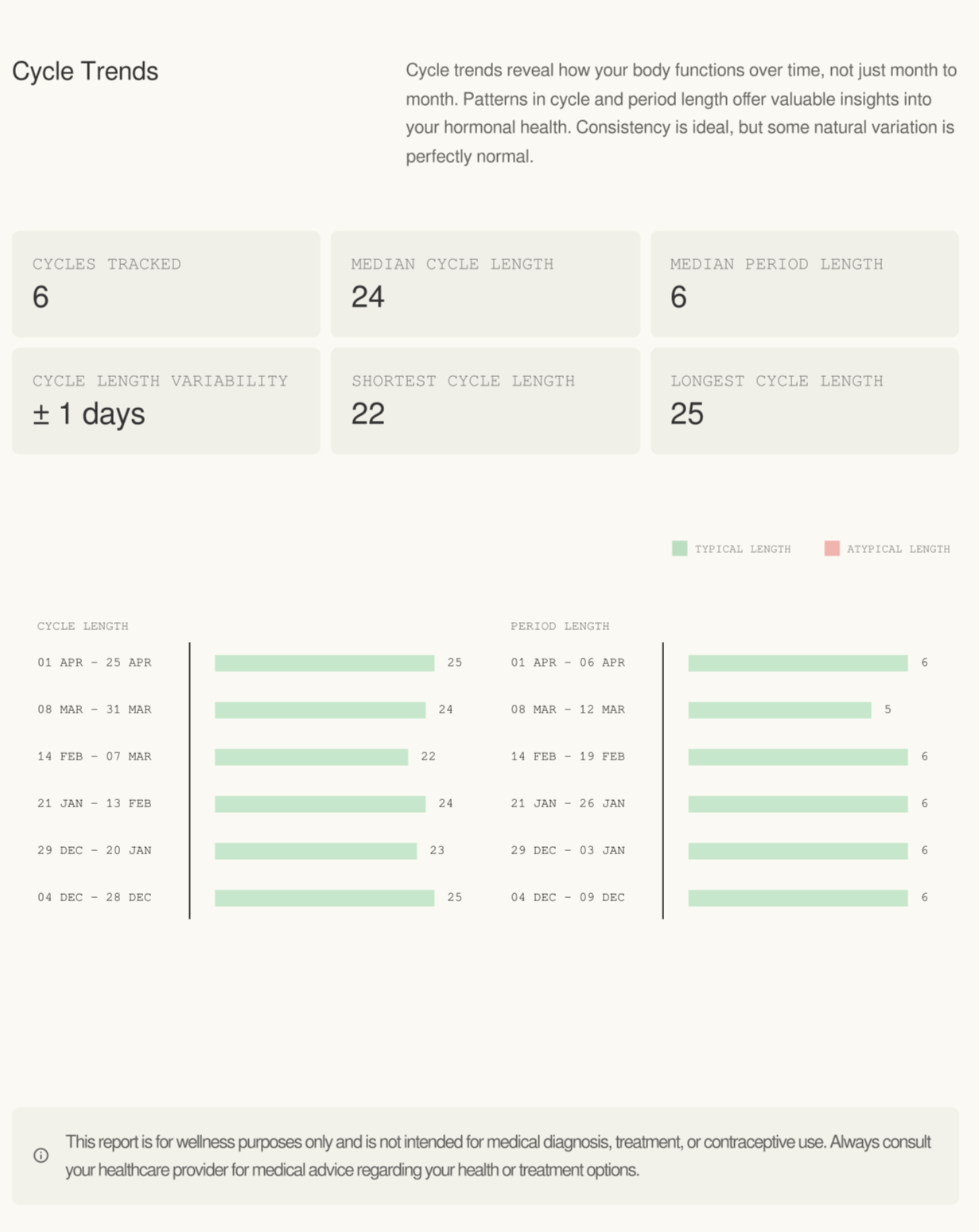
Here's the picture my ring has built so far. I want to be upfront that I'm still in the early stages (a few months in) and some of this is still building into something more conclusive. But even at this stage, there are things in here that no app has ever told me.
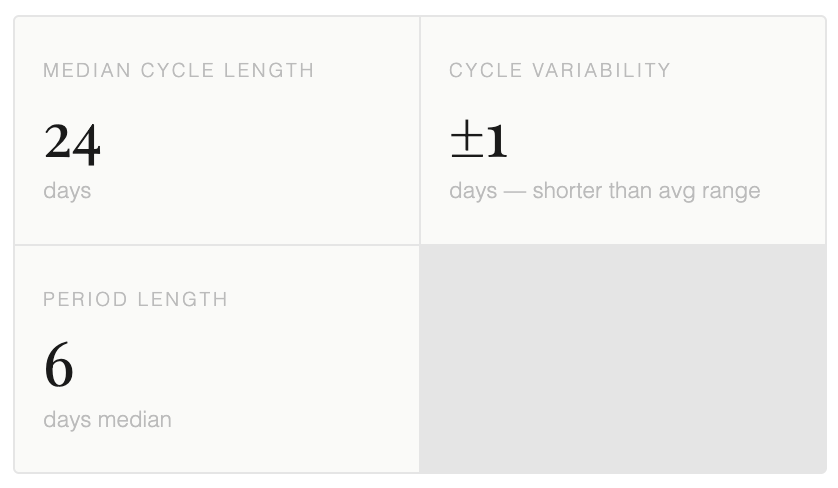
The thing that surprised me most was the ±1 day variability. Every app I'd ever used had suggested my cycle was fairly unpredictable, but looking at it now, the range between my shortest cycle (22 days) and longest (25 days) is just three days. That's not an unpredictable cycle. That's a short-but-consistent cycle that was being misread because the prediction model was calibrated for 28 days.
Knowing my cycle actually runs around 24 days rather than the assumed 28 has already changed how I think about planning. In practical terms, it means I'd been consistently off by nearly a week in my mental calculations.
Ovulation: Confirmed, Estimated, or Flagged
This is the part of the data I find most interesting and the part where I appreciate the app's honesty most.
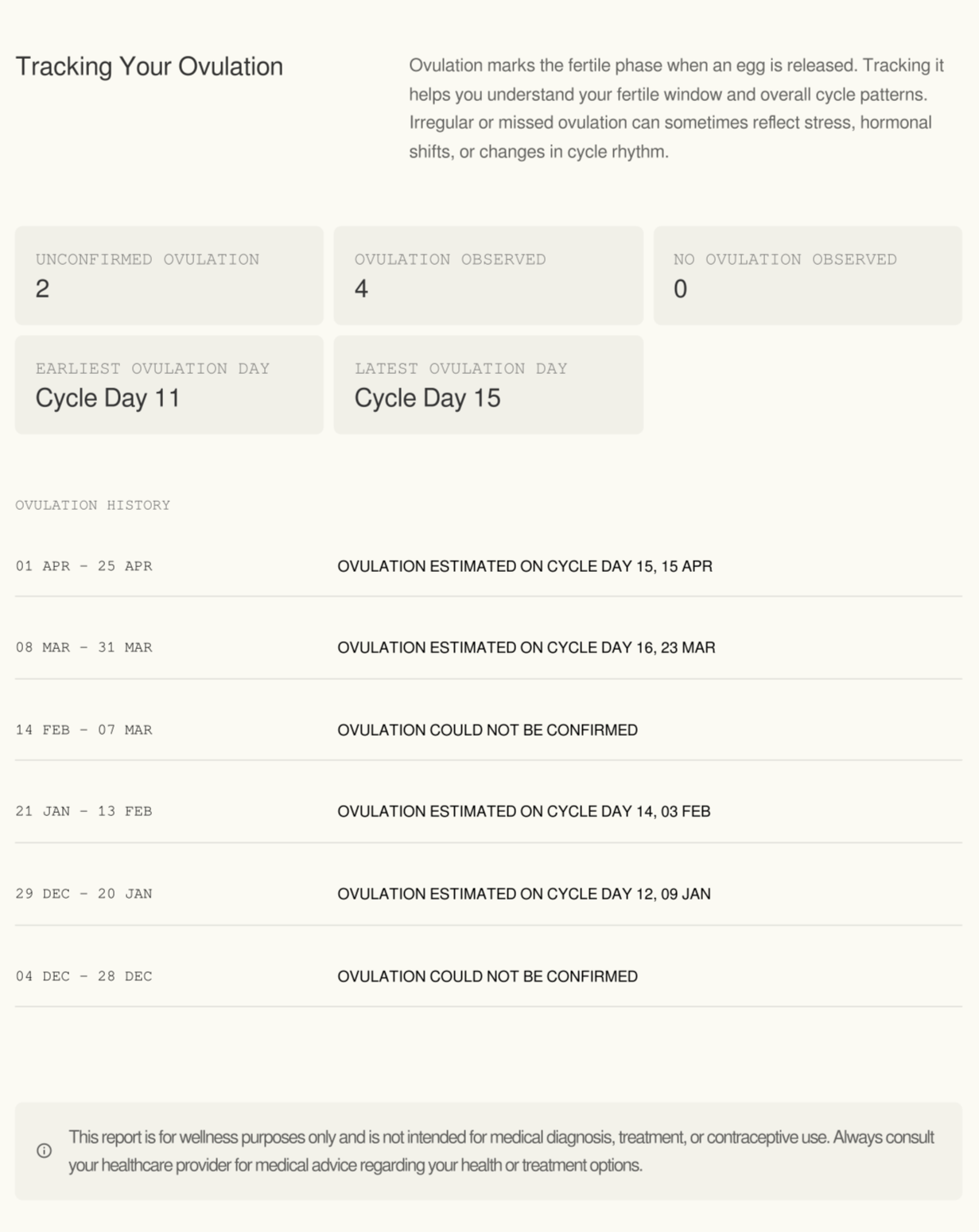
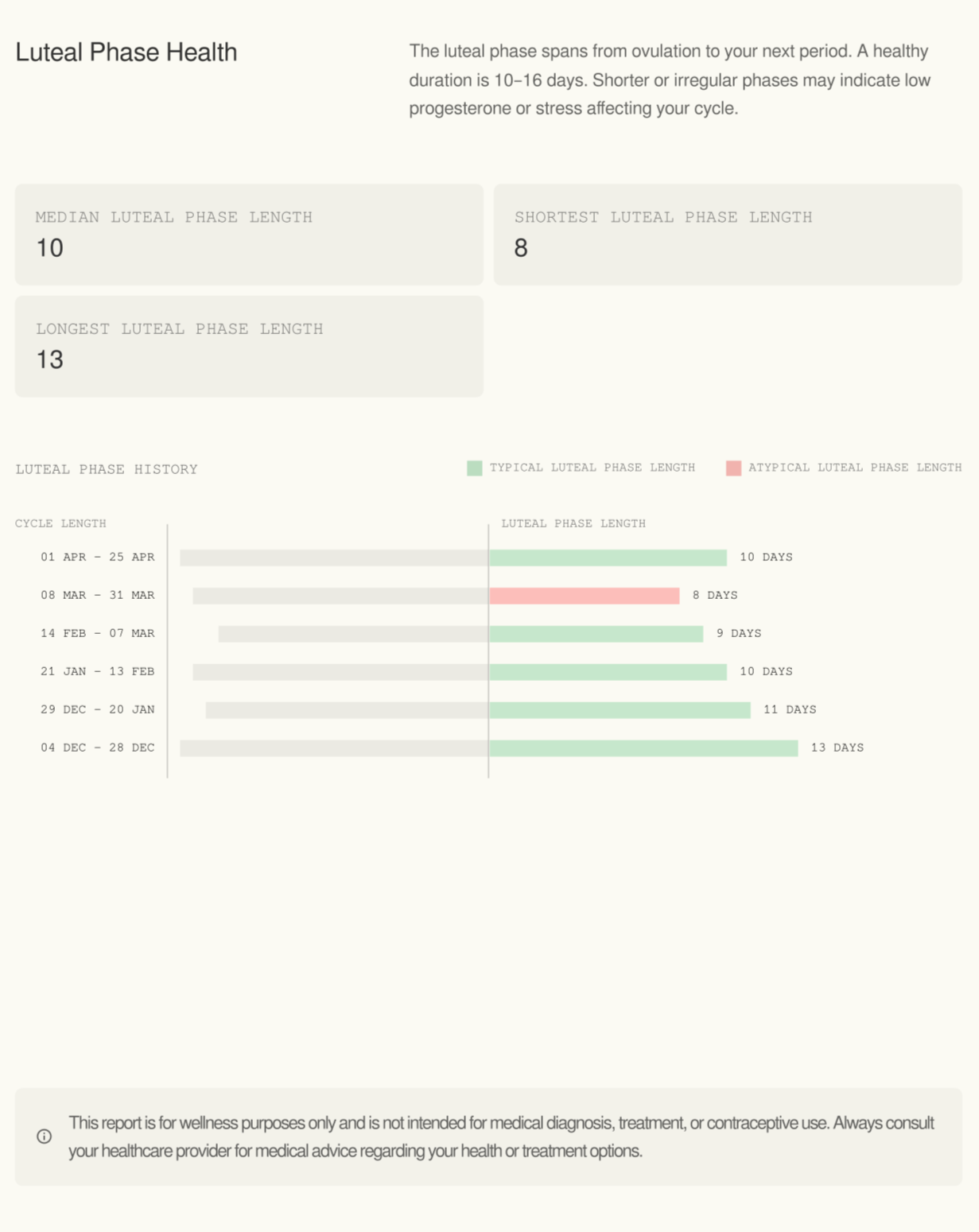
Across my tracked cycles so far, ovulation was identified in most of them, typically between cycle day 11 and 15. In a couple of cycles it was estimated rather than confirmed, and in two it couldn't be confirmed at all.
Temperature tracking depends on consistent sleep data, and when that data is fragmented, the algorithm flags the uncertainty rather than guessing. I really value that. An app that makes up an answer when it doesn't have enough data is actively less useful than one that says "I'm not sure."
Cycle Flags: Patterns You Wouldn’t Otherwise Notice
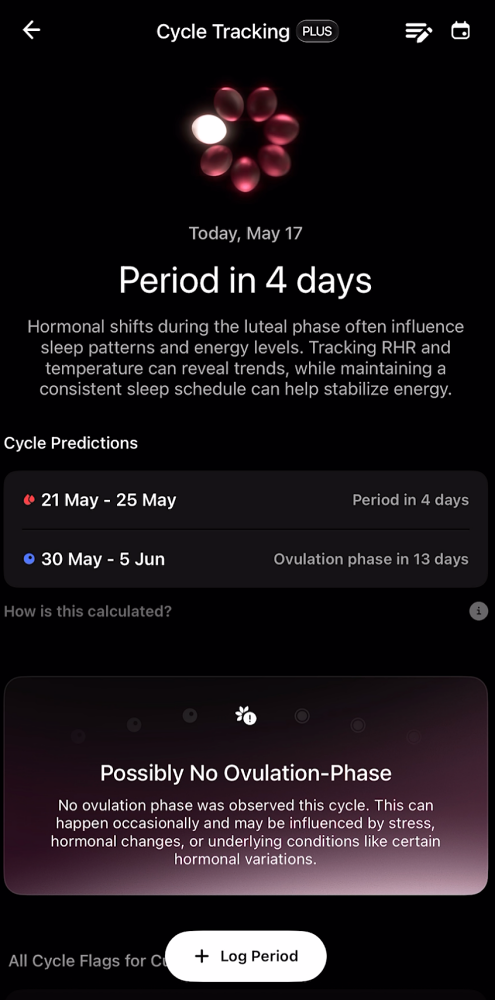
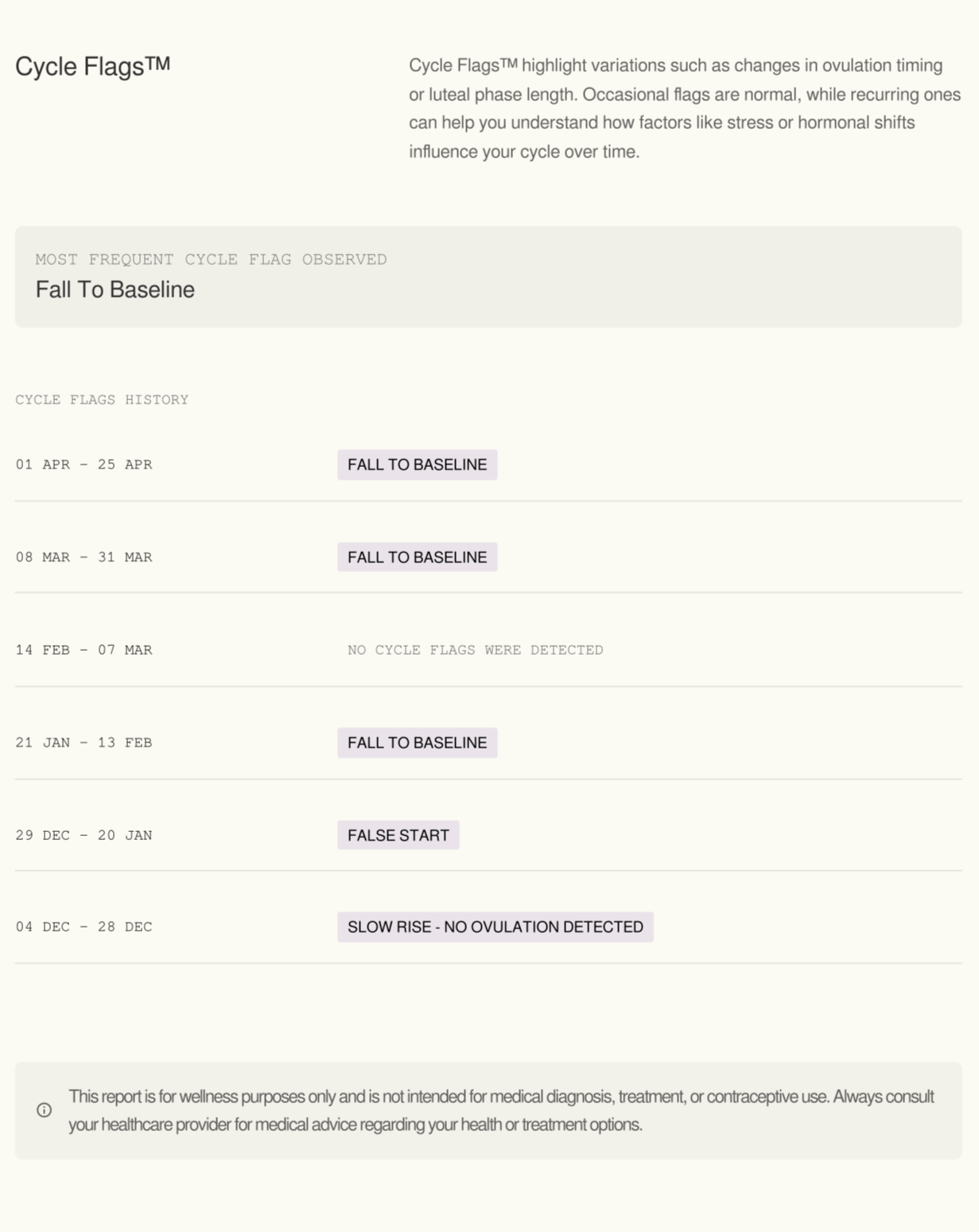
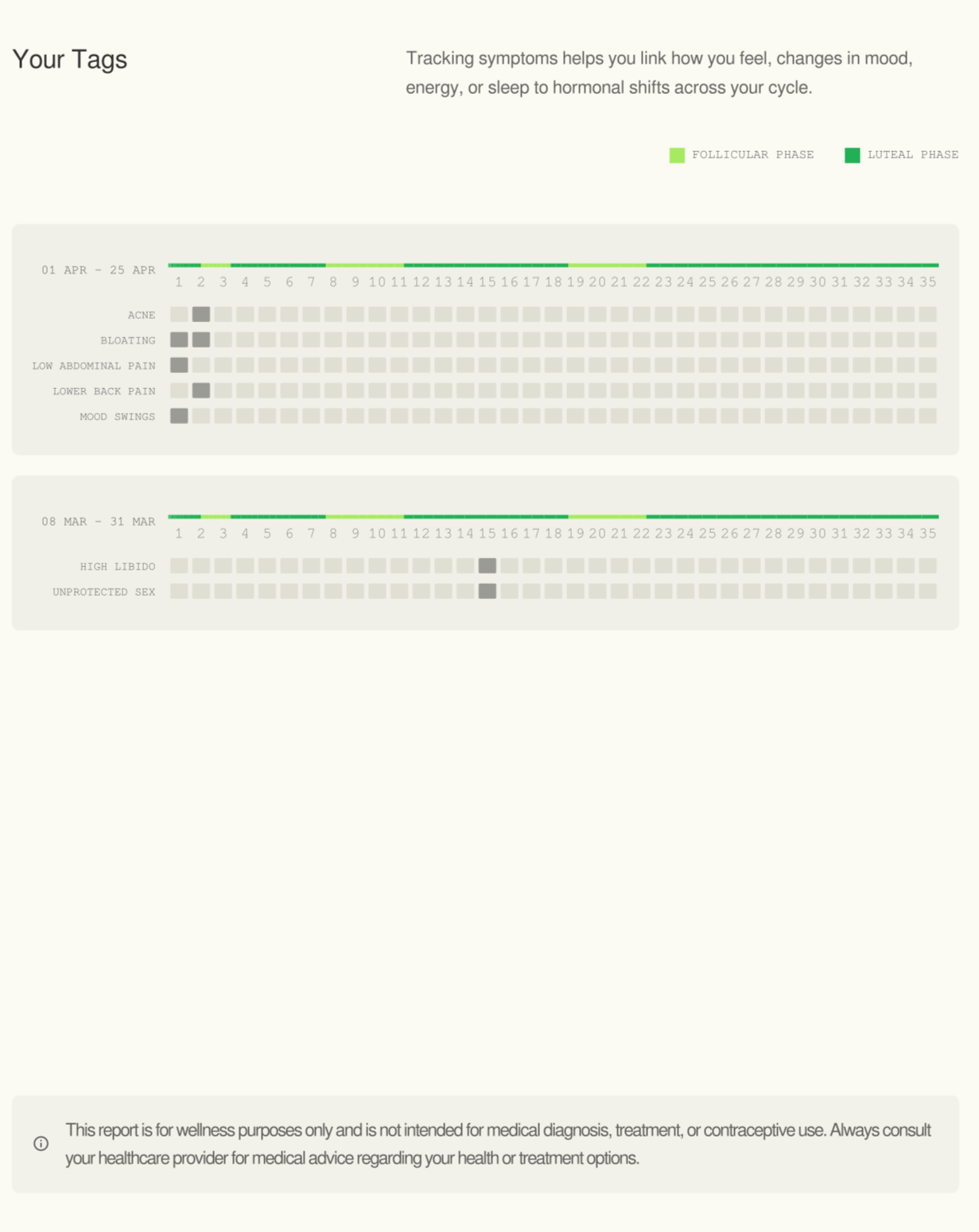
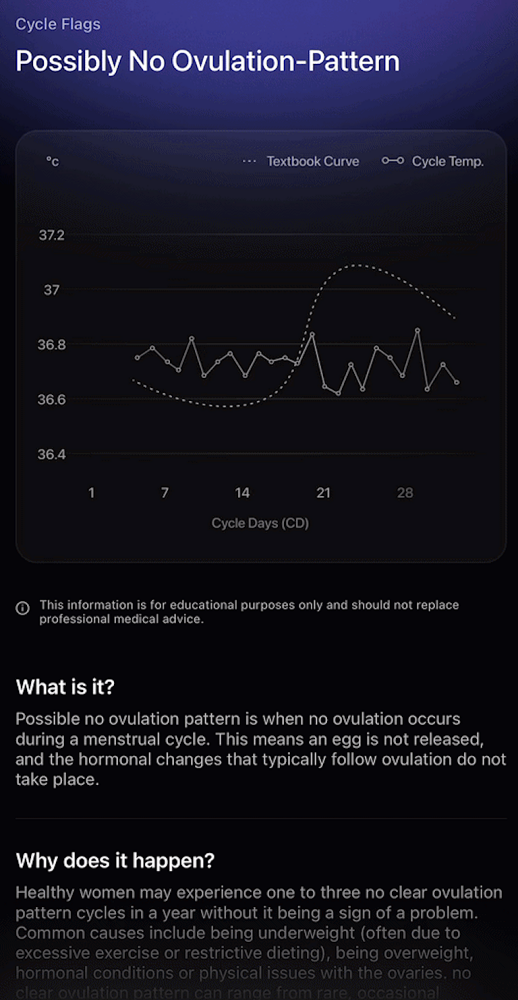
The Cycle Flags™ feature is something I hadn't seen in any app before. These are markers the algorithm applies when it spots patterns in your temperature data worth paying attention to — things like an early or late ovulation, an unusual rise and fall, or an absence of ovulation entirely.
Mine so far:
Fall to Baseline x 3
False Start x 1
Slow Rise – No ovulation detected x 1
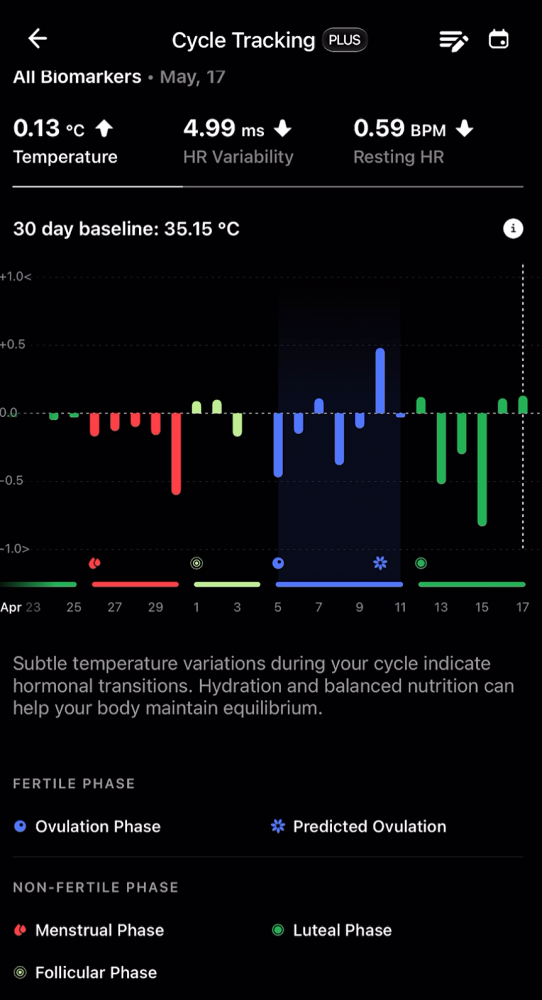
The recurring Fall To Baseline flag, which appeared in three of my tracked cycles, suggests my temperature rose towards the ovulation threshold and then dropped back before confirming. The Slow Rise – No Ovulation Detected flag showed up in one of the earlier cycles, during a period where I was travelling a lot and sleeping badly.
I won't pretend I fully understand all of this yet. I'm a few months in, not a gynaecologist. But having names for these patterns, and understanding that they're grounded in temperature data rather than calendar maths, at least gives me something concrete to look into or mention to a doctor if I wanted to. That's more than I had from any previous app.
The Sleep and Temperature Tracking

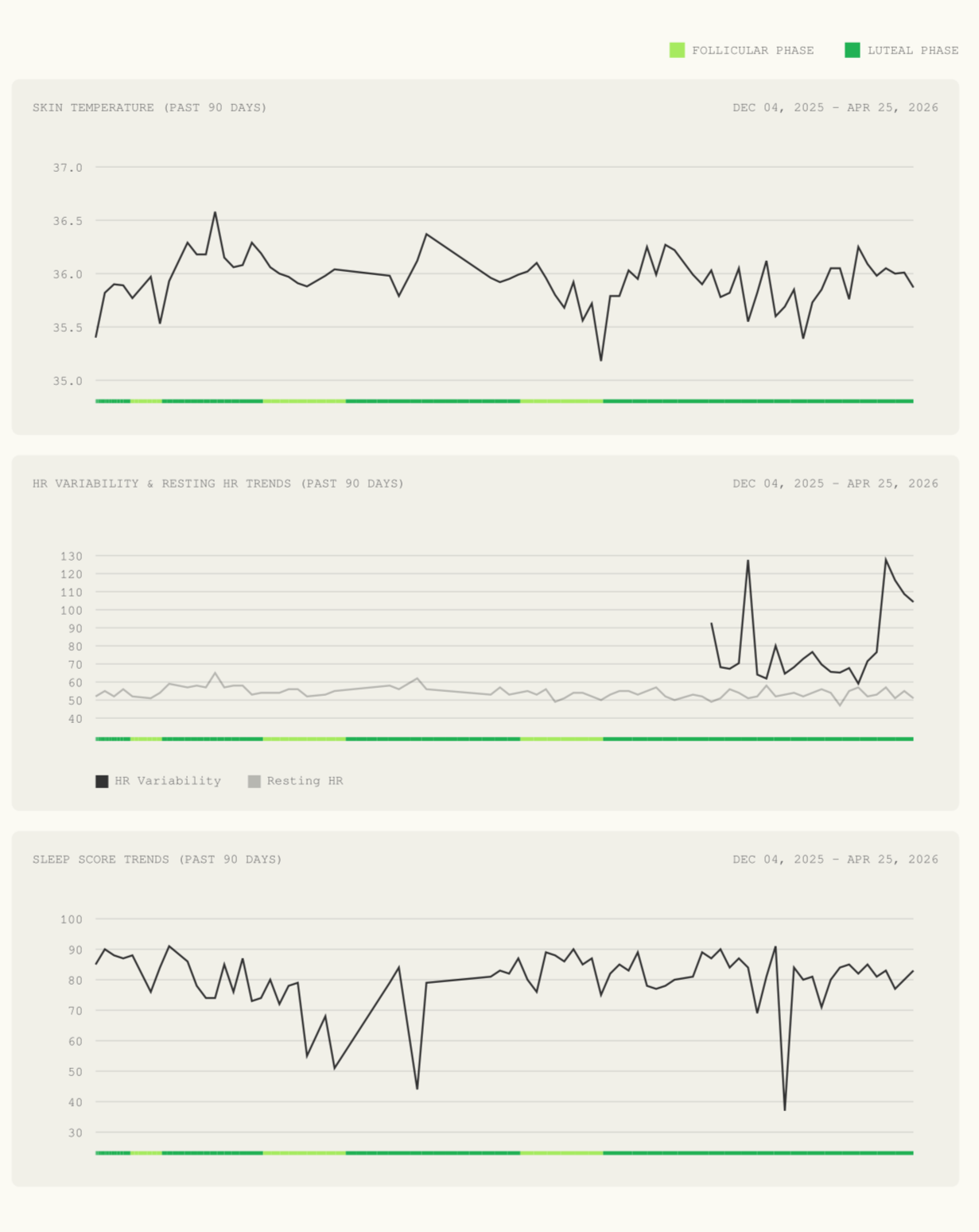
The biometric data underneath the cycle tracking is useful on its own too. My sleep scores ranged from the high 80s during quieter weeks to the high 40s during the worst stretches of travel or stressful weeks. My skin temperature tracks the expected cycle pattern reasonably clearly in the more settled cycles, a lower baseline in the follicular phase, a visible rise after ovulation. In the disrupted cycles, that pattern is flatter, which maps directly onto those "unconfirmed ovulation" months.
There's also an HRV story in the data that I'm still piecing together; a significant spike in readings from around February onwards that coincides with a change in how I was sleeping and training. The ring doesn't tell me what caused it, but it makes the question visible in a way it wasn't before.
So, Is It Worth It?

What works:
No manual logging, passive and consistent
Grounded in clinical technology, not calendar averages
Honest about uncertainty, won’t fabricate data
Cycle Flags surface patterns you’d never spot yourself
Works for short, long, or irregular cycles
Ring is lightweight, waterproof, 24/7 wearable
Worth knowing:
Takes 2-3 cycles to feel genuinely useful
The Cycle & Ovulation Pro PowerPlug is a paid add-on
Data-heavy app, takes some getting used to
Please note: The Cycle & Ovulation Pro PowerPlug is powered by an adapted version of the OvuSense™ algorithm, originally developed as an FDA-cleared Class II medical device for fertility tracking, and adapted here for general wellness use. It is not intended as a medical tool, contraceptive, or substitute for professional medical advice.